
Let me be honest with you: I’ve been there. Most people trying weight loss at home have been there, struggling to find a sustainable rhythm. You start with the best intentions — a new set of resistance bands, a printed meal plan taped to the fridge, a phone alarm set for 6 a.m. workouts. Then life happens. Work happens. Exhaustion happens. And suddenly it’s three weeks later and nothing has changed except you feel a little worse about yourself than before.
That cycle isn’t a character flaw. It’s a design flaw — in the way we’ve been taught to approach health without support, without structure, and without anyone holding us accountable. But here’s what’s changing: your home doesn’t have to be where good intentions go to die. It can genuinely become the most powerful place in your health journey. We just need to talk honestly about why it usually isn’t.

The “DIY” Trap: Why Most Weight Loss at Home Attempts Fail Without a Plan
There’s a quiet epidemic of failed home weight loss attempts — not because people are lazy, but because they’re working without a roadmap. The appeal of doing it yourself is obvious. No gym membership fees. No awkward weigh-ins with a stranger in scrubs. No commute. You can do weight loss at home on your own schedule, in your own space. The freedom is intoxicating — until the freedom becomes the problem.
Without external structure, most people fall into what researchers call “reactive eating” — making food decisions based on mood, availability, and stress rather than intention. You open the fridge not because you’re hungry, but because you’re bored, anxious, or lonely. The kitchen, which should be a tool, becomes a coping mechanism. The living room, which could be a workout space, stays a place of rest and escape.
The other piece of the DIY trap is information overload. A ten-second search for “how to lose weight at home” returns thousands of conflicting opinions: low-carb, high-protein, intermittent fasting, intuitive eating, zone training, HIIT — pick your religion. Without someone helping you apply the right approach to your specific body, metabolism, and lifestyle, most people either try everything at once and crash, or get paralyzed and do nothing.
3 signs you’re stuck in the DIY trap
- You’ve restarted the same “plan” more than twice with no structural changes
- Your approach relies entirely on willpower — no accountability, no check-ins
- You’ve never had your metabolism, hormones, or dietary patterns assessed by a professional

Setting the Environment: Turning Your Home into a Sanctuary for Metabolic Health
Here’s a reframe that changed everything for me: your home is not a place to lose weight. It’s a place to build the habits that produce weight loss. That distinction sounds subtle, but it’s enormous in practice. The goal isn’t to suffer in your living room — it’s to engineer your environment so that healthy choices become the path of least resistance.
Start with what behavioral scientists call “friction.” High-friction environments make healthy habits harder. Low-friction environments make them default. If your workout clothes are buried in a drawer and your couch is the first thing you see when you wake up, you’ve built a high-friction environment for at-home weight loss strategies. If your resistance bands are next to your coffee maker and your running shoes are by the door, you’ve reversed the friction.
The same principle applies to your kitchen. Research consistently shows that food visibility directly drives consumption. A bowl of fruit on the counter gets eaten. A bag of chips at eye level in the pantry disappears. You’re not lacking willpower — you’re lacking environmental design. Restructure your space like you’d restructure a workspace for productivity. Intentionally. Architecturally.
But environment alone won’t get you there. The single biggest variable missing from most home-based metabolic health attempts is human connection — specifically, expert guidance tailored to you. Not a YouTube fitness influencer. Not a Reddit thread. A real, qualified professional who understands your body, your history, and your goals. That used to require a commute, a waiting room, and a co-pay that made your eyes water. It doesn’t anymore — and that’s exactly what Part 2 of this guide is going to address.
Because the most important shift in weight loss at home isn’t a new exercise routine or a stricter grocery list. It’s understanding that you don’t have to figure this out alone — and that the help you need is now available from the same couch where you’ve been watching Netflix.

The Biological Shield: How Your Body Reacts to Home-Based Exercise and Caloric Changes
You start eating less. You start moving more. And for about two weeks, it works beautifully. Then something invisible happens — your body, in all its evolutionary wisdom, decides you are under attack. It doesn’t know you’re trying to fit into last summer’s jeans. It knows: energy is scarce, movement is high, and it needs to protect you. So it adapts. And it adapts in ways that feel profoundly unfair.
This is the biological shield — the cluster of hormonal and metabolic responses that make sustained weight loss at home so much harder than the first two weeks suggest. Ghrelin, your hunger hormone, climbs. Leptin, your satiety signal, drops. Your resting metabolic rate quietly decreases. Your brain starts finding food more rewarding, not less. None of this is your fault. All of it is working exactly as designed — designed for a world where caloric scarcity meant survival, not a structured home fitness plan.
Truth be told, this is the moment most home-based attempts collapse — not because the person gave up, but because nobody told them the biology was about to push back. Knowledge of the mechanism is itself a form of resistance.
The good news: this shield can be navigated. Consistent protein intake (roughly 0.7–1g per pound of body weight) significantly blunts the ghrelin response. Resistance training — even basic bodyweight work in your living room — signals to your body that muscle is essential and worth preserving, which protects your metabolic rate far better than cardio alone. Strategic caloric cycling, where you eat at maintenance two or three days per week, can also prevent the full hormonal adaptation cascade. None of this is magic. It’s just working with your biology instead of assuming willpower can override it.
Beyond Cardio: The Importance of Sleep and Stress Management at Home
Here’s what nobody talks about when they sell you a home-based metabolic health plan: you can eat perfectly and train consistently and still stall completely — if you’re sleeping five hours a night and running on cortisol. Sleep isn’t recovery. Sleep is the primary driver of hormonal regulation, and hormonal regulation is the invisible engine of every fat-loss result you’re chasing.
A single night of poor sleep raises ghrelin levels by up to 28% and drops leptin by a comparable margin. That’s not a minor variable. That’s essentially undoing a week of disciplined eating in one sleepless night. Weight loss at home without sleep optimization is like trying to fill a bathtub with the drain open. You can keep pouring, but the math never works in your favor.
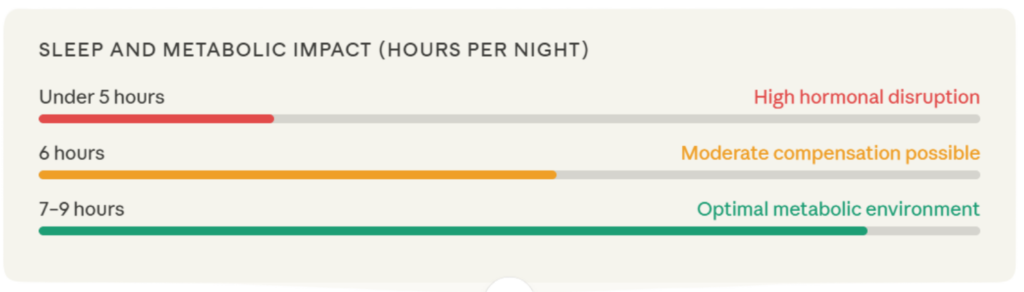
Stress compounds this further. Chronic cortisol elevation — from work, relationships, financial pressure, or simply the low-grade anxiety of modern life — directly promotes visceral fat storage, particularly around the abdomen. Your body under stress is hoarding energy, not releasing it. This is why two people can follow identical at-home weight loss strategies and see completely different results: one is sleeping well and managing stress; the other is running on adrenaline and coffee and wondering what they’re doing wrong.
The intervention here doesn’t require a therapist or a silent retreat. It requires honesty about your nervous system. A ten-minute wind-down before sleep — no screens, dim light, something genuinely calming — measurably improves sleep quality. Structured breathing exercises lower cortisol within minutes. Even a five-minute walk outside mid-afternoon can interrupt the stress accumulation cycle and reset your body’s threat response. None of this is complicated. All of it matters more than the specific diet you’re following.
And here’s the thread that connects all three sections — kitchen, biology, sleep — into a single, honest truth: weight loss at home is not a willpower project. It’s an environment project, a biology project, and a nervous system project happening simultaneously. Which means the version of you that succeeds isn’t stronger or more disciplined than the version that failed before. They’re just better informed — and better supported. That support piece is exactly what Part 3 is going to address head-on.
The Telehealth Revolution: Bringing the Doctor to Your Living Room
Not long ago, accessing a licensed physician for medical weight loss from home meant scheduling an appointment weeks out, sitting in a waiting room full of strangers, and hoping your fifteen-minute slot was enough to actually address the complexity of your situation. For millions of people — especially those without reliable transportation, flexible work hours, or nearby specialists — that system was simply out of reach. That has changed. Quietly, significantly, and permanently.
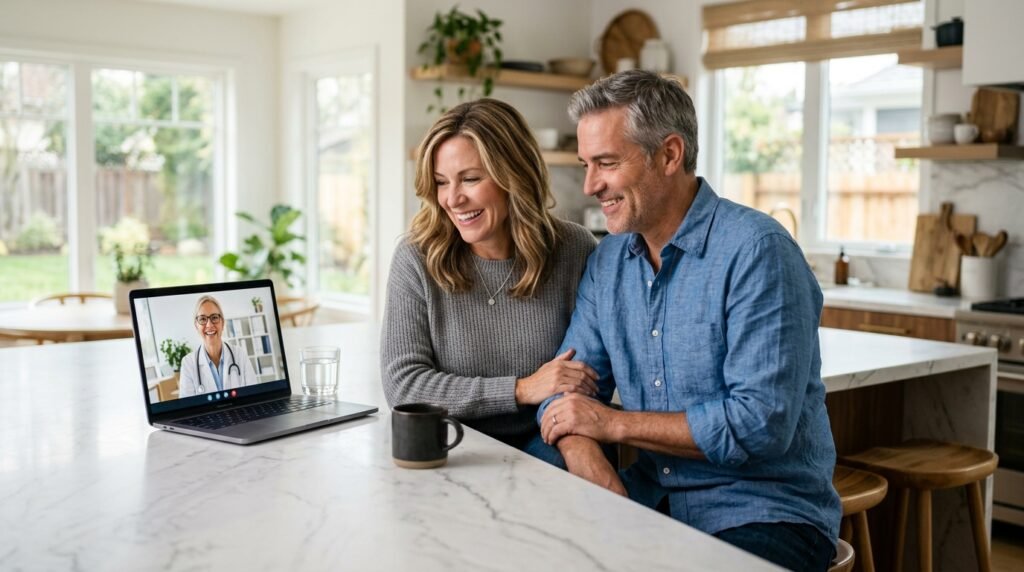
Telehealth has restructured the relationship between patients and providers in a way that finally makes sense for how people actually live. Today, a board-certified physician specializing in metabolic health or obesity medicine can evaluate your labs, review your history, and build a personalized weight loss at home protocol — all through a video call you take from your kitchen table. No commute. No waiting room. No judgment. Just clinical expertise delivered to wherever you happen to be.
Intake and health history review
A licensed provider reviews your full medical background, current medications, metabolic markers, and weight history — the context that generic apps never ask for.
Personalized protocol design
A plan built for your biology — not a template. Nutritional targets, movement recommendations, and where clinically appropriate, prescription options discussed openly.
Ongoing check-ins and adjustments
Regular virtual follow-ups to assess progress, recalibrate the plan, and address the hormonal and metabolic shifts that happen as your body adapts.
Accountability without shame
A real human professional in your corner who knows your name, your history, and your goals — not an algorithm sending you push notifications.
The clinical evidence supporting telehealth weight loss support is not anecdotal. Studies published in peer-reviewed journals over the past four years consistently show that patients in structured telehealth weight management programs achieve outcomes comparable to — and in some markers superior to — in-person programs. The key driver isn’t the technology. It’s the consistency of contact and the personalization of the plan. Both are now available without leaving your living room.

Bridging the Gap: When Lifestyle Isn’t Enough, Professional Support Is the Missing Piece
Here’s something the wellness industry doesn’t profit from telling you: for a significant portion of people struggling with weight, the problem is not motivational. It’s physiological. Thyroid dysfunction, insulin resistance, hormonal imbalances, medications that cause weight gain as a side effect — these are clinical variables that no amount of meal prepping or morning walks can fully overcome without medical evaluation. That’s not defeatism. That’s biology being honest with you.
Truth be told, the gap between “trying everything” and “finally seeing results” is often a single properly run blood panel and a conversation with someone who can interpret it. Licensed online doctors for weight loss can order labs, identify underlying conditions, and make evidence-based decisions about whether lifestyle intervention alone is sufficient or whether additional clinical support — nutritional, hormonal, or pharmacological — is warranted for your specific case.
The most honest thing I can tell you is this: if you’ve been doing everything “right” and still not seeing movement, the answer probably isn’t trying harder. It’s getting a clearer picture of what’s actually happening inside your body — and that picture requires a professional to read it.
This is the gap that affordable weight loss at home through telehealth is designed to close. Not to replace your effort — you still have to do the work — but to make sure that work is actually aimed at the right target. A plan that doesn’t account for your cortisol levels, your sleep quality, your hormonal baseline, and your metabolic rate isn’t a plan. It’s a guess. And you’ve spent enough time guessing.
Medical Disclaimer: This content is for informational purposes only and does not constitute medical advice. Always consult with a healthcare professional before starting any weight loss program. Please seek proper guidance to ensure your safety and well-being. The information on this site is not intended to replace professional clinical consultation.
Pingback: online safety red flags
Здравствуйте!
Я представляю сервис HRB2C по приёму платежей от физических лиц в рублях, в том числе для проектов с повышенным риском жалоб по платежам. Оплата осуществляется по платёжным ссылкам с QR-кодом.
Вывод средств доступен в рублях и USDT.
Наш сайт: https://hrb2c.com/
Хотим предложить вам сотрудничество. Если предложение актуально, готовы обсудить условия и ответить на ваши вопросы.
Будем ждать обратной связи. Спасибо!