

Most diets don’t fail because you lack discipline. They fail because they were never designed to work long term.
You know the pattern. You commit to a new plan on Monday. You cut carbs. You download a tracking app. You promise yourself, this time will be different. The first week? Motivating. The scale drops. You feel lighter, maybe even proud.
Then something shifts.
Your energy dips. Cravings creep in. Social events feel stressful. One “off” meal turns into a weekend spiral. And suddenly you’re right back where you started—sometimes heavier than before.
That’s the yo-yo effect. And if you’ve experienced it, I want you to hear this clearly: you are not broken.
The problem isn’t you. It’s the approach.
Most weight loss advice focuses on extremes. Extreme restriction. Extreme workouts. Extreme rules. But your body is not designed to thrive under extremes. It’s designed to survive them. When you slash calories or eliminate entire food groups, your metabolism adapts. Hunger hormones rise. Energy drops. Your brain becomes more preoccupied with food.
That’s biology, not weakness.
This is why we’re going to talk about Healthy Weight Loss differently here.
Not from a “quick fix” angle. Not from a detox or miracle supplement perspective. And definitely not from a place of shame.
We’re focusing on science. Real physiology. Hormones. Metabolism. Behavior change. The stuff that actually determines whether weight loss lasts beyond a few weeks.
Because here’s what I’ve learned after years of studying nutrition science and working with real people: Sustainable change happens when you work with your body instead of fighting it.
Healthy Weight Loss isn’t about becoming smaller at any cost. It’s about improving body composition, protecting muscle, stabilizing hormones, and building habits you can maintain for years—not just until summer.
You deserve clarity, not confusion.
So in this deep dive, we’re breaking down what actually works, why it works, and how you can apply it in a realistic way.
No fads. No hype. Just science—explained like we’re sitting across from each other having an honest conversation.

The Metabolic Engine: More Than Math
You’ve heard it before: “It’s just Calories In vs. Calories Out.”
Technically? A calorie deficit is required to lose weight. That part is true.
Here’s the thing…
Your body controls both sides of that equation.
When you slash calories aggressively, your metabolism doesn’t sit there politely. It adapts.
- Your resting metabolic rate decreases.
- You subconsciously move less.
- Hunger signals intensify.
- Fatigue increases.
Think of it this way: your body sees severe calorie restriction as a threat. It responds by conserving energy. That’s not sabotage. That’s survival.
This is why two people can eat the same number of calories and experience different results. Hormones, muscle mass, stress levels, sleep quality—all of it influences how efficiently your body burns or stores energy.
So yes, calories matter. But hormones decide how those calories are used.
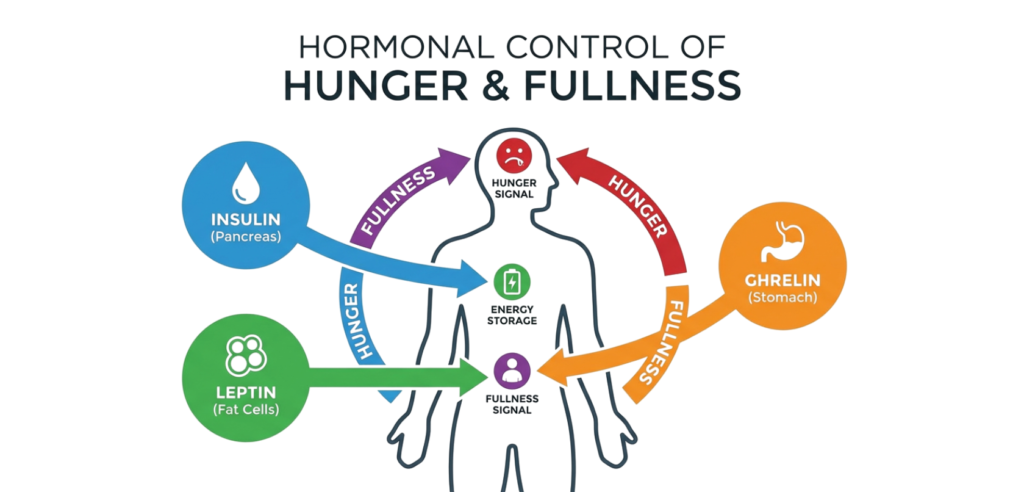
Insulin: The Storage Gatekeeper
Insulin gets blamed for everything. It’s not the villain. It’s a regulator.
When you eat carbohydrates, your blood sugar rises. Insulin steps in and escorts that glucose into your cells for energy or storage.
The problem isn’t insulin itself. The issue is chronic overexposure.
If you constantly consume highly refined carbs without movement, your cells can become less responsive. This is called insulin resistance.
When that happens:
- Your body produces more insulin.
- Higher insulin levels encourage fat storage.
- Fat burning becomes less efficient.
Healthy Weight Loss improves insulin sensitivity. Strength training, balanced meals with protein and fiber, and consistent movement make your cells more responsive again.
It’s about restoring balance, not eliminating carbs.
Leptin & Ghrelin: The Hunger Duo
Now let’s talk about appetite regulation.
Leptin is your “I’m full” hormone. It signals to your brain that you have enough stored energy.
Ghrelin is the “I’m hungry” hormone. It rises before meals and drops after eating.
Simple enough.
But here’s where it gets interesting.
When you diet aggressively:
- Leptin levels drop.
- Ghrelin levels rise.
- Hunger increases.
- Cravings intensify.
Your body is trying to protect you from starvation.
Short-term dieting works because you overpower these signals temporarily. Long-term Healthy Weight Loss works because you avoid triggering extreme hormonal responses in the first place.
Adequate protein helps lower ghrelin. Sleep supports leptin regulation. Resistance training helps stabilize appetite hormones.
This isn’t about fighting your biology.
It’s about understanding it.
Once you do, the process feels less frustrating—and far more predictable.
Protein: The Most Underrated Fat-Loss Tool
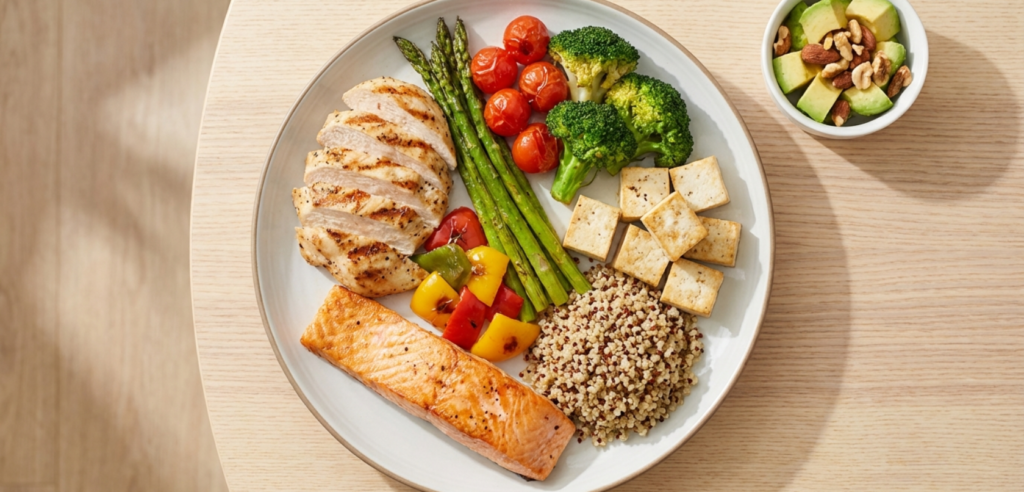
If I had to prioritize one macronutrient for Healthy Weight Loss, it would be protein. Every time.
Here’s why.
Protein directly influences your hunger hormones. It reduces ghrelin (your “I’m hungry” hormone) and increases peptide YY and GLP-1, which signal fullness to your brain. That means you naturally feel more satisfied after meals.
And then there’s the Thermic Effect of Food (TEF).
Think of TEF as the energy cost of digestion. Your body has to burn calories to break down food. Protein is metabolically expensive to process. Roughly 20–30% of its calories are burned during digestion.
Compare that to:
- Carbohydrates: about 5–10%
- Fats: around 0–3%
So when you eat 100 calories of protein, your body may only net 70–80 usable calories. That’s a meaningful difference over time.
But wait, there’s more.
Protein also protects muscle mass during a calorie deficit. And preserving muscle keeps your metabolism stronger. Lose muscle, and your metabolic rate drops. Maintain it, and you protect your long-term fat-loss engine.
A practical target for many people aiming for Healthy Weight Loss? Around 0.7–1 gram of protein per pound of body weight.
Not extreme. Just intentional.
Fiber: The Quiet Game-Changer
Fiber doesn’t get flashy headlines. It should.
Fiber slows digestion, stabilizes blood sugar, and increases satiety. When blood sugar rises gradually instead of spiking, insulin remains more stable. That means fewer crashes and fewer intense cravings later.
And here’s something fascinating: fiber feeds your gut bacteria.
Your gut microbiome plays a role in appetite regulation, inflammation, and even insulin sensitivity. When you consume fiber-rich foods—vegetables, fruits, legumes, whole grains—you nourish beneficial bacteria that produce short-chain fatty acids. These compounds improve metabolic health and may support fat loss indirectly.
Low-fiber diets? They often lead to higher hunger levels and more reliance on ultra-processed foods.
Healthy Weight Loss isn’t about eating less food. It’s about eating more nutrient-dense food that keeps you full longer.
Carbs: Not the Villain
Let’s clear this up.
Carbohydrates are not inherently fattening.
Your brain runs on glucose. Your muscles use glycogen for performance. Carbs are fuel.
The problem isn’t carbohydrates. It’s refined carbohydrates.
Highly processed foods—white bread, sugary cereals, pastries, sweetened drinks—digest quickly. They spike blood sugar. Insulin rises sharply. Hunger returns fast.
Whole-food carbs? Very different story.
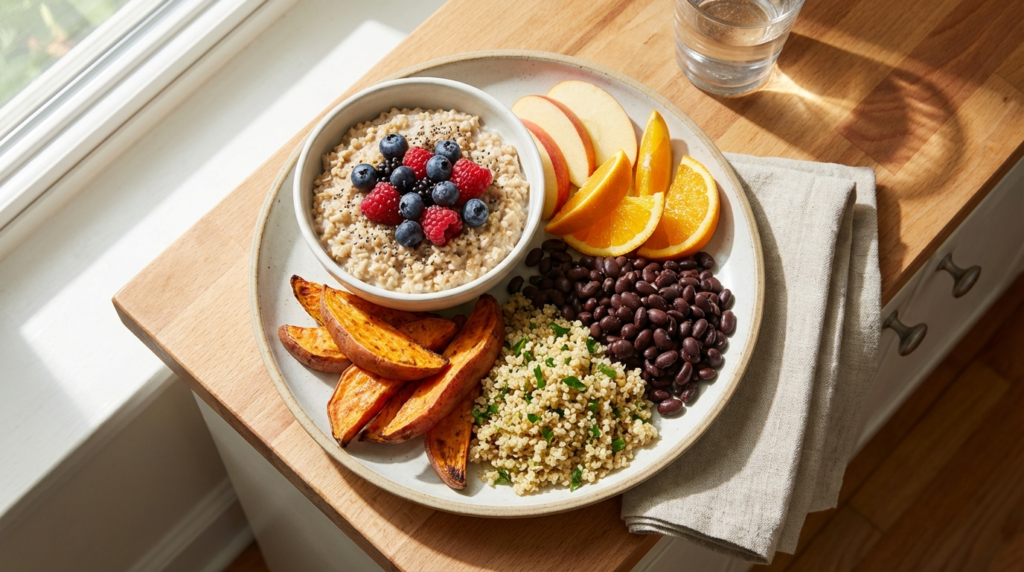
Think:
- Oats
- Sweet potatoes
- Quinoa
- Beans
- Fruit
These contain fiber, micronutrients, and slower-digesting starches that provide sustained energy.
Healthy Weight Loss doesn’t require eliminating carbs. It requires upgrading them.
Pro Tip (From Experience)
If you struggle with nighttime snacking, try this:
Build your dinner around:
- A palm-sized portion of protein
- Two fists of vegetables
- A moderate serving of whole-food carbs
- A small portion of healthy fats
Most people undereat protein during the day and overcompensate at night. When you front-load protein and fiber earlier, cravings drop dramatically by evening.
It’s not about perfection.
It’s about structure.
When you focus on food quality—adequate protein, high fiber, minimally processed carbs—you reduce hunger, stabilize energy, and make Healthy Weight Loss feel less like a battle and more like a rhythm.
Let’s talk about something that changes the entire trajectory of Healthy Weight Loss.
Muscle.
I like to call muscle the “metabolic tax” you actually want to pay. Because unlike most taxes, this one gives you returns.
Muscle tissue is metabolically active. It requires energy just to exist. The more lean muscle mass you carry, the more calories your body burns at rest. Not dramatically overnight—but steadily, consistently, in the background.
And that adds up.
When people focus only on dieting and long cardio sessions, they often lose both fat and muscle. The scale drops, yes. But their metabolic rate drops too. They become smaller… and more metabolically fragile.
That’s not a win.
Healthy Weight Loss protects muscle while reducing fat. And that’s where resistance training comes in.
So, do you really need to run a marathon to lose fat? Not exactly.
Steady-state cardio has benefits. Heart health. Stress reduction. Endurance. But hours of it—especially in a calorie deficit—can increase fatigue, elevate cortisol, and sometimes lead to muscle loss if nutrition isn’t dialed in.
Strength training, on the other hand, sends a different signal to your body.
It says: “This muscle is needed. Keep it.”
When you lift weights:
- You stimulate muscle protein synthesis.
- You improve insulin sensitivity.
- You increase post-exercise calorie burn (thanks to excess post-exercise oxygen consumption).
- You enhance bone density and joint stability.
And here’s the quiet bonus: strength training improves body composition even when the scale moves slowly. You may lose inches before pounds.
Now let’s zoom out.
Your total daily energy burn isn’t just workouts. A huge portion comes from NEAT—Non-Exercise Activity Thermogenesis. That’s the energy you burn walking, cleaning, standing, fidgeting, living.
When calories drop too low, NEAT often drops unconsciously. You move less. Sit more. Conserve energy.
Smart movement for Healthy Weight Loss includes:
- Strength training 3–4 times per week.
- 7,000–10,000 steps per day.
- Short walks after meals.
- Staying generally active throughout the day.
It’s not extreme. It’s strategic.
You’re building a body that burns efficiently, moves well, and feels strong—not one that survives on restriction and endless cardio.
Muscle isn’t about looking bulky.
It’s about becoming metabolically resilient.
And that changes everything.
Let’s be honest.
You can meal prep perfectly. You can hit your workouts. You can track every gram of protein.
But if you’re sleeping five hours a night and running on stress fumes… Healthy Weight Loss becomes an uphill battle.
I’ve seen it over and over.
You have a demanding job. Deadlines pile up. Your phone never really stops buzzing. You stay up late to “unwind,” but you’re scrolling instead of resting. The alarm goes off too soon. You’re groggy. You grab something quick and sugary because you’re exhausted.
That’s not a motivation problem. That’s biology.

Cortisol: Helpful… Until It’s Not
Cortisol is your primary stress hormone. In short bursts, it’s useful. It helps you wake up. It mobilizes energy. It keeps you alert.
But chronic stress keeps cortisol elevated for long periods.
And elevated cortisol does a few things that directly interfere with Healthy Weight Loss:
- Increases appetite, especially for high-sugar, high-fat foods
- Raises blood sugar levels
- Promotes fat storage, particularly around the abdomen
- Disrupts sleep cycles
Your body interprets chronic stress as a threat. It prepares for survival. Fat storage becomes protective.
Now layer sleep deprivation on top of that.
Sleep Deprivation and Sugar Cravings
When you don’t sleep enough, two key hormones shift:
- Ghrelin (hunger hormone) increases
- Leptin (fullness hormone) decreases
Translation? You feel hungrier and less satisfied after eating.
Studies show that even one night of restricted sleep can increase cravings for refined carbohydrates and ultra-processed foods. Your brain is seeking quick energy because it’s tired.
That’s why after a bad night’s sleep, donuts suddenly look irresistible.
Healthy Weight Loss isn’t just about what you eat. It’s about whether your body is rested enough to regulate appetite properly.
Practical Ways to Lower Cortisol
You don’t need to eliminate stress. That’s unrealistic. You need to manage it.
Here are science-backed strategies that work:
- Prioritize 7–9 hours of sleep. Consistent bed and wake times matter more than you think.
- Get morning sunlight. It helps regulate your circadian rhythm.
- Lift weights instead of overdoing long cardio sessions.
- Practice slow breathing (4–6 breaths per minute for a few minutes).
- Take short walks during the day, especially after meals.
Small actions. Big hormonal impact.
Healthy Weight Loss becomes far more sustainable when your nervous system feels safe.
You can’t punish your body into change.
You have to support it.
Let’s talk about the part most people avoid.
Your mindset.
You can understand calories. You can memorize macros. But if your relationship with food is built on restriction, guilt, and “starting over Monday,” Healthy Weight Loss will always feel temporary.
Here’s some tough love.
If you’re constantly swinging between being “perfect” and completely off track, the problem isn’t your willpower. It’s the all-or-nothing mindset.
You eat one cookie and think, I blew it.
So you eat five more.
Then promise to restrict harder tomorrow.
That cycle is exhausting.
Mindful eating interrupts it.
Mindful eating isn’t slow-motion chewing or meditation music at dinner. It’s paying attention. Eating without distractions. Noticing hunger and fullness cues. Asking yourself, Am I actually hungry—or just stressed, bored, tired?
It creates space between impulse and action.
And space changes everything.
Healthy Weight Loss is built on habits, not heroic bursts of motivation. Habits are boring. Repetitive. Almost unremarkable.
But they compound.
Instead of chasing a temporary diet, build a baseline:
- Protein at most meals.
- Vegetables daily.
- Strength training weekly.
- Walking consistently.
- Sleeping intentionally.
Not perfectly. Consistently.
You don’t need to be extreme. You need to be steady.
The goal isn’t to control food. It’s to remove its emotional power over you.
When you stop labeling foods as “good” or “bad,” you make calmer choices. When you allow flexibility, you reduce rebellion. When you focus on identity—“I’m someone who takes care of my body”—your actions align naturally.
Healthy Weight Loss isn’t a 30-day sprint.
It’s a shift in how you think, decide, and show up for yourself daily.
And that shift? That’s where real transformation begins.
By now, you can probably see the pattern.
Healthy Weight Loss isn’t about starving yourself. It isn’t about punishing workouts or eliminating entire food groups. It’s about understanding your biology, protecting your muscle, stabilizing your hormones, managing stress, and building habits you can actually live with.
Nothing extreme.
Just aligned.
So where do you start?
A Simple 3-Step Action Plan
Step 1: Anchor Your Protein.
At your very next meal, prioritize protein first. Build the plate around it. This one shift alone improves satiety, protects muscle, and stabilizes appetite hormones.
Step 2: Lift Something This Week.
Two or three strength sessions. Nothing fancy. Just intentional resistance training to tell your body: “We’re keeping this muscle.”
Step 3: Protect Your Sleep.
Set a consistent bedtime tonight. Lower the lights. Put the phone down 30 minutes earlier. Better sleep improves hunger control more than most diets ever will.
You don’t need a complete life overhaul.
You need a strong first step.
Healthy Weight Loss happens when small, intelligent actions compound over time. Stay consistent. Stay patient. Work with your body—not against it.
You are not broken. You are capable. And this time, you’re building something that lasts.
Medical Disclaimer: This content is for informational purposes only and does not constitute medical advice. Always consult with a healthcare professional before starting any weight loss program. Please seek proper guidance to ensure your safety and well-being.